Laboratory testing confirmed 99.6% purity. The next step is to build two demonstration units to validate the technology at a larger scale.
The global carbon black market amounts to about 15 million metric tons a year, worth more than $20 billion, and is growing by roughly 5% annually. Tires account for two-thirds of demand. Other uses include industrial rubber products such as seals, conveyor belts and drive belts, as well as plastics, coatings, paints and inks. Most carbon black is made from petroleum feedstock. Asia accounts for about 58% of global demand, making supply diversification a strategic issue for the industry.
Recovered carbon black (rCB) is a smaller segment growing several times faster than the wider market. It is estimated at about 138,000 metric tons in 2026, with annual growth of more than 20%. It represents less than 1% of the overall market. Conventional recovered grades generally fall short of higher-specification grades and sell at a 20–30% discount to virgin carbon black, which limits uptake by tire makers. Major tire brands' environmental commitments are driving demand for recycled inputs, while electric mobility and batteries require high-purity conductive grades.
The world generates roughly 26 million metric tons of end-of-life tires annually, of which less than 20% is recycled. The source below also discusses disposal and energy recovery.
The ECO OASIS complex is designed to produce 117,000 metric tons of carbon black per year. Laboratory testing achieved the target purity of 99.6%. This volume represents less than 1% of the global carbon black market. Potential applications include premium tires, engineered rubber products and batteries. Suitability for each use must be demonstrated against buyers' specifications.
| Metric | ECO OASIS | Other tire recyclers |
|---|---|---|
| Product purity | 99.6% | Comparable to N500–N700 grades |
| Substitution potential | Virgin carbon black made from petroleum | Partial substitution in blends with virgin carbon black |
| Exposure to oil prices | No direct exposure through feedstock, which is waste | No direct feedstock exposure, though selling prices are linked to virgin grades |
ECO OASIS is designed to make carbon black from end-of-life tires with purity comparable to petroleum-based products. The process uses waste feedstock and is designed to limit CO₂ emissions per metric ton of product.
End-of-life tires are shredded into rubber crumb with a specified particle size. The design uses a top-fed screw conveyor and several days of buffer storage to keep production running through temporary disruptions in tire deliveries.
Rubber crumb is thermally decomposed in an oxygen-free environment at a controlled temperature. Conventional pyrolysis equipment is commercially available from multiple suppliers. The process yields untreated carbon black, pyrolysis oil, pyrolysis gas and other valuable fractions.
ECO OASIS's international research team developed a plasma reforming process for pyrolysis oil and gas. Reforming recovers carbon from these streams for the main product. The design case projects 117,000 metric tons of product from 185,000 metric tons of tires, a yield of about 63% versus 30–35% for conventional pyrolysis. The process is also designed to produce hydrogen and recover heat for power generation. The complex can use that electricity on site and potentially sell any surplus.
ECO OASIS's proprietary process achieved 99.6% purity in laboratory testing. The result is recorded in a test report, with the original available to investors after signing a confidentiality agreement. Commercial grades and applications are subject to further testing.
Shredding and conventional pyrolysis use equipment that is commercially available and widely used. The team's own developments are the reforming and purification stages. In the project model, adding those stages to a conventional pyrolysis plant produces a higher-purity product and triples revenue from the same volume of tires.
A purification unit can also be installed alongside an existing pyrolysis plant and process its untreated carbon black. This offers a standalone application of the technology without construction of the full complex or development of a dedicated tire supply.
Current stage. Purification achieved 99.6% purity in the laboratory, as recorded in the test report. Plasma reforming has been demonstrated on model mixtures. The first project phase will build demonstration units. Investors and their specialists can observe testing and submit sealed feedstock and product samples for independent analysis.
ECO OASIS protects the process as confidential know-how. Process knowledge is divided between two independent research groups, each with access to its own part of the technology.
These figures assume full design capacity of 117,000 metric tons of carbon black per year at a target purity of 99.6%. A smaller initial plant can be built and expanded in stages. The parameters for a smaller configuration are determined separately.
The projected margin reflects the difference between feedstock and finished product. End-of-life tires are a waste stream for which disposal fees apply in many countries. The output is high-purity carbon black, a product conventionally made from petroleum. Operating costs are based on 964 positions at the full complex and include repairs, insurance and site upkeep.
The cost structure differs from that of conventional carbon black manufacturers. The project materials cite an EBITDA margin of around 19% for Cabot and a low of 6% in 2026 for Orion's rubber segment. Conventional production depends on petroleum-based feedstock bought at market prices. ECO OASIS uses end-of-life tires as its feedstock.
The table shows how operating earnings change under adverse conditions.
| Scenario | Annual EBITDA | Margin |
|---|---|---|
| Base case | $156m | |
| Operating costs up 20% | $143m | |
| Revenue down 20% | $112m | |
| Revenue down 20% and operating costs up 20% | $99m |
In the combined scenario, a 20% increase in operating costs and a 20% drop in revenue leave the projected EBITDA margin above 50%.
The team presents purity, yield and financial figures using the lower end of its working estimates. The demonstration program is intended to test those assumptions.
Capital costs vary by location, particularly land, construction, utility connections and local requirements. The $331 million base estimate includes a 10% contingency. Candidate sites in several countries were reviewed for logistics, utilities, water and staffing. A site-specific estimate follows site selection.
The financial model, internal rate of return (IRR), net present value (NPV), payback period and downside scenarios are discussed after a confidentiality agreement is signed. The model tests lower selling prices, higher operating costs and a slower ramp-up.
After signing a confidentiality agreement, investors receive the financial model, inputs and assumptions for independent review with their advisers. The Partnership section explains how the project is structured and who is responsible for each decision.
Before building the full complex, ECO OASIS will build two demonstration units, one for plasma reforming and one for its proprietary purification process. These units will be used to evaluate material behavior across different feedstocks, repeatability and the process parameters needed for scale-up.
The investor has audit and site-visit rights for both laboratories during the pilot program and can verify results directly.
The pilot program is planned to run for two years. The investor may start building a conventional tire shredding and pyrolysis plant in parallel, roughly six months after the project begins. The plant is designed with future expansion in mind.
During preparation, the investor handles corporate arrangements, land, permits, financing and relations with local authorities. ECO OASIS prepares the site-specific engineering work: surveys and geotechnical investigations, drawings and cost estimates, utility and load calculations, construction sequencing, payment schedules, and support with contractor, supplier and staffing decisions.
The investor and ECO OASIS work from separate offices, ideally on different floors of the same building, to coordinate closely during preparation. Temporary power, water, site facilities and tool storage are arranged before machinery arrives so construction can begin without basic site services holding it up.
The investor decides whether to expand the conventional plant into the full complex after reviewing the demonstration results for reforming and purification.
Successful demonstration can open the way to offtake agreements and technology licensing before the full complex is built. Once the complex is operating, the units serve as a calibration laboratory for adapting the process to variation in feedstock.
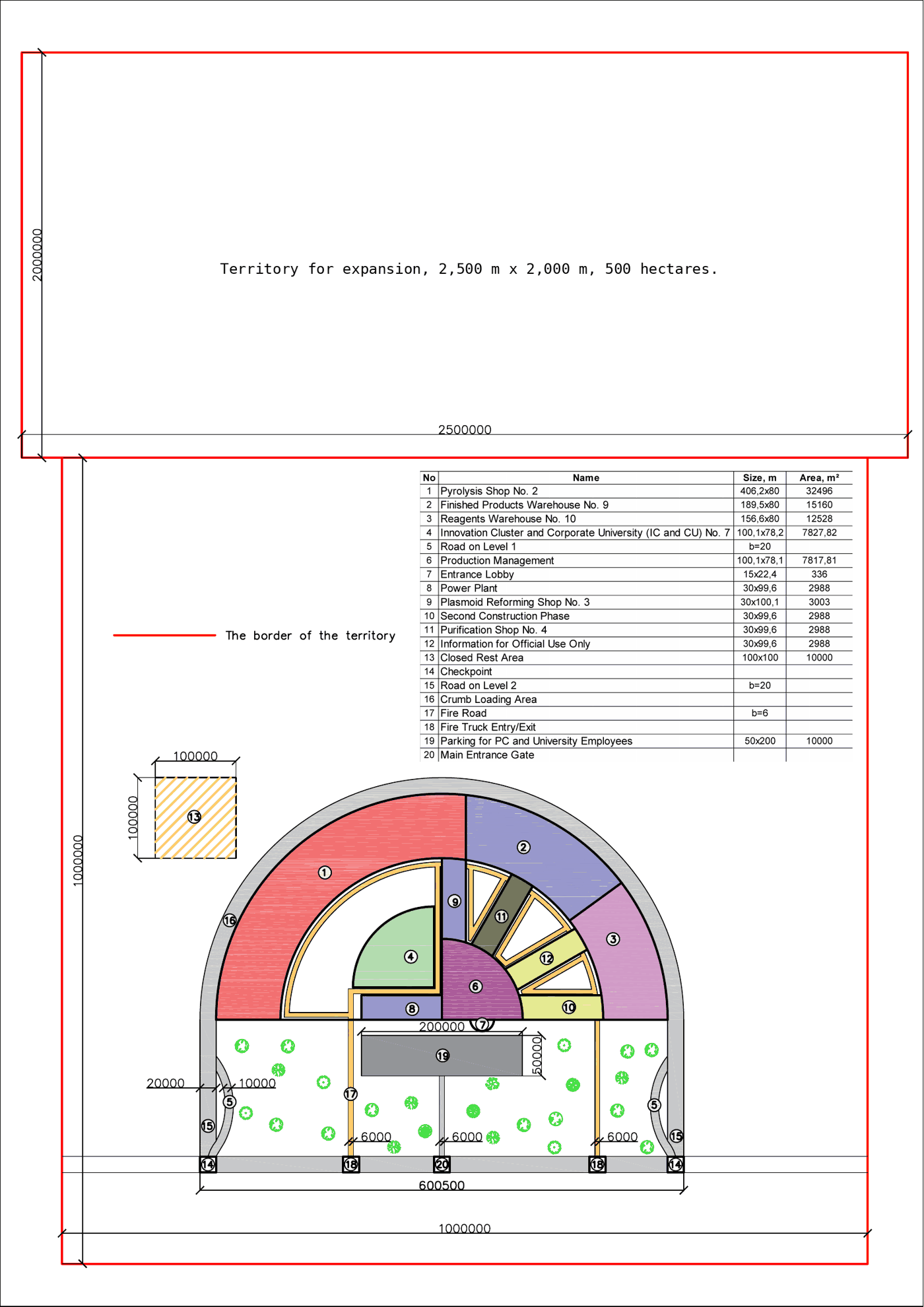
| No. | Facility | Dimensions, m | Area, m² |
|---|---|---|---|
| 1 | Pyrolysis building | 406.2×80 | 32,496 |
| 2 | Finished goods warehouse | 189.5×80 | 15,160 |
| 3 | Reagent warehouse | 156.6×80 | 12,528 |
| 4 | Innovation cluster and corporate university | 100.1×78.2 | 7,827.82 |
| 5 | Level 1 road | b = 20 | — |
| 6 | Plant administration | 100.1×78.1 | 7,817.81 |
| 7 | Entrance facilities | 15×22.4 | 336 |
| 8 | Steam power plant | 30×99.6 | 2,988 |
| 9 | Plasma reforming building | 30×100.1 | 3,003 |
| 10 | Phase 2 construction area | 30×99.6 | 2,988 |
| 11 | Proprietary purification building | 30×99.6 | 2,988 |
| 12 | Technical area (details available under NDA) | 30×99.6 | 2,988 |
| 13 | Private recreation area | 100×100 | 10,000 |
| 14 | Security checkpoint | — | — |
| 15 | Level 2 road | b = 20 | — |
| 16 | Rubber crumb loading area | — | — |
| 17 | Fire access road | b = 6 | — |
| 18 | Fire vehicle entrance and exit | — | — |
| 19 | Employee parking | 50×200 | 10,000 |
| 20 | Main entrance gate | — | — |
Utility networks and technical areas are disclosed at a meeting after a non-disclosure agreement (NDA) is signed.
Tire shredding and conventional pyrolysis form a standalone industrial operation. Once commissioned, the plant can produce pyrolysis oil, steel cord, standard-grade carbon black and other outputs independently of the demonstration program.
For a conventional plant processing 185,000 metric tons of tires per year, estimated investment is about $118 million and projected annual revenue is about $73 million (±10%).
We recommend reserving approximately 500 hectares next to the complex for future tire or engineered rubber production using its carbon black.
Technology validation and construction of the conventional plant can proceed in parallel. The full complex is built by expanding that plant after a successful demonstration.
Two demonstration units for plasma reforming and proprietary purification.
Two independent research groups work in parallel. Each can deliver results independently.
The investor receives an ownership interest in the project company and priority rights to build the full complex, on terms set out in an agreement.
Investors can participate at the laboratory stage, ahead of the demonstration. A successful demonstration reduces technology risk and changes the terms of entry for subsequent participants.
Tire shredding and conventional pyrolysis use established industrial technology.
The investor organizes and funds construction and contracts directly with equipment, commissioning and training providers, with support from ECO OASIS if requested. ECO OASIS provides technical supervision from site preparation through start-up. The working schedule allows around three years from groundbreaking to start-up and a further six months to reach full capacity. The result is an operating plant and a trained team.
The plant is designed for expansion into the full complex. Buildings, utilities, land and access roads allow additional capacity and process areas to be added in the second phase.
The conventional plant can operate independently of research-phase results.
The plant is expanded with ECO OASIS technology to produce carbon black at a target purity of 99.6% and generate electricity on site.
The expansion is considered after the demonstration units have been shown in operation.
A smaller initial capacity can be expanded in stages.
Figures are estimates (±10%) and are refined for the selected site.
The conventional plant can operate as a standalone business with established technology, multiple equipment suppliers and existing markets for its products. If the demonstration succeeds, the same plant can be expanded. The model estimates roughly three times the revenue from the same tire volume, with improved financial returns. The conventional plant can also continue as an operating asset with a trained team, with the option of selling it as a going concern. The project team can discuss the assumptions behind any potential resale premium.
The investor controls the capital and makes decisions on land, permits, financing, appointment of the general contractor and construction.
The ECO OASIS team does not handle project funds.
Technical management and oversight by engineers with hands-on experience building industrial complexes on greenfield sites.
Technical specifications, visits to contractor sites, quality and schedule oversight, and support in selecting the operations team.
ECO OASIS maintains an on-site presence throughout construction.
The parties agree in writing how to handle disagreements. If the investor disagrees with a technical recommendation, the investor makes the final decision and signs a record of it. The project team documents its technical position.
The investor contracts with a single company, GENESUS 2008 LLP of Kazakhstan. The research and engineering teams work as subcontractors, with the company accountable to the investor. The legal structure for the selected site, whether in a special economic zone or the host country's mainland jurisdiction, is determined after the initial documents are signed: a memorandum of understanding (MOU), a non-disclosure agreement (NDA) and a cooperation agreement.
The project entity in the host country works with a general contractor, which coordinates specialist engineering and research partners. The structure assigns separate responsibility for funding and technical work while maintaining a single line of oversight for quality and schedule.
The project protects its technology as confidential know-how. Access is divided within the research team, so no single person or group has the full process. The investor's specialists can discuss the scope of protection and how it was verified after signing an NDA.
ECO OASIS draws on researchers with institutional experience who developed the project's plasma reforming and proprietary carbon black purification processes. Access to process knowledge is divided among specialists as part of the protection strategy.
The engineering team has built greenfield industrial complexes, including chemical manufacturing facilities. It applies that experience to technical oversight of the ECO OASIS build.
The broader team has more than 80 patents and inventor certificates from previous work and more than 50 research publications, and has presented at international conferences. Including trainees and external specialists, the group comprises more than 70 people. The current ECO OASIS technology is managed as confidential know-how, as described in the Partnership section.
The ECO OASIS team covers the full development cycle, from fundamental research to industrial engineering. Its people can build the first complex, replicate it and train other teams to operate it.
Names and professional biographies are disclosed after the relevant documents are signed. Access to the people and the process follows the same confidentiality approach. Investors can meet the researchers in person or when signing the main agreement. Demonstration results can be measured and samples analyzed by an independent laboratory.
Sign agreements and release funding. The first three to six months cover approvals, site-specific design, surveys and selection of the general contractor. Construction can then begin. Both research teams work in parallel on the demonstration units, targeting 24 months ±2 months to show the results to the investor and invited buyers.
The working schedule allows around three years from groundbreaking to start-up. A further six months are planned for ramp-up at 25%, 50%, 75% and 100%, with roughly one and a half months per stage as production lines and staff are added. The overall range from groundbreaking to full capacity is 2.5 to 3.5 years.
Engineering documentation, established process designs, trained teams and the research center can shorten the build schedule for subsequent sites. Growth can come through facilities built by ECO OASIS or technology licensing.
Laboratory testing has demonstrated carbon black purity of 99.6%. The complex also includes a research center that will support production and strengthen the host country's industrial capabilities.
The center is a separate component of the complex, with dedicated premises, staff and funding within the operating budget. It is designed to begin work alongside production.
Once the complex opens, the two demonstration units serve as a calibration laboratory for adapting operating parameters to changes in tire feedstock. The center also carries out product quality control and trains operators, engineers, teams for future sites and licensees.
The center trains people for the first complex, future ECO OASIS projects and companies that license the technology. Its longer-term goal is to help the host country develop its own research capabilities over a ten-year period, from plasma chemistry to industrial catalysis.
Scientists work on site and mentor trainees on real production problems. The goal is for the host country to have its own specialists in plasma chemistry, catalysis and materials who can lead subsequent projects independently within ten years.
The investment supports both carbon black production and a center for research and industrial expertise. The center can continue to build capability after the initial plant investment is recovered.
The center supports environmental, social and governance (ESG) objectives and national priorities such as economic diversification and technology development. For investors, it also provides a base for developing expertise and applying it to future projects.
Additional project materials are available on request after initial contact.